

Why design gets undervalued
And what companies and designers can do about it

Design is how you solve marketing and product problems, which sounds obvious until you realize most companies treat it like a separate thing entirely. It’s like hiring a chef to plate food someone else cooked. Sure, presentation matters, but if the underlying dish is bland or the recipe is off, all the microgreens in the world won't save you.
Most companies organize design as its own function, sitting between marketing and product but belonging to neither. When they decide they need a rebrand or new website, they're asking for design without figuring out what problem they're trying to solve.
I’ve seen this pattern everywhere, from my time at Twitter to the companies in my investment portfolio to the work we do at Off-Menu. The difference between struggling teams & fast-growing ones often comes down to how they think about design. The struggling ones treat it as its own silo, disconnected from real business problems. The fast-growing ones embed design in marketing and product, where it’s solving for outcomes that matter.
Where I see most brands leaving money on the table
When you organize design as its own silo, your designers could be solving conversion problems that add millions to pipeline or retention problems that reduce churn by double digits. Instead they’re making decks look nice and waiting for briefs. Your CMO has pipeline numbers, your head of product has retention numbers, and design has what? Brand perception? That's why you're debating whether to keep your design team, while your competitors are using design to steal your customers.
Look at the companies growing fastest. Their designers own the same outcomes as marketing and product teams. Marketing designers own conversion and differentiation, product designers own usability and activation. Better yet, designers lead those functions entirely. When design is measured on business results instead of aesthetics, you stop debating taste and start showing ROI.
If you’re a designer, here’s how you change the conversation
When someone reaches out asking for a rebrand or a new website, your first three questions are: What business problem are we solving? What metric are we trying to move? Who gets fired if this doesn’t work?
Then push deeper. If they say “our website needs a refresh,” ask what’s broken about it. Is conversion low? Are people bouncing because they don’t understand what you do? Are you losing deals to competitors who look more credible? Each of those is a different problem with a different solution, and “make it look modern” solves none of them.
Most designers are trained in execution, make it beautiful and ship it on time. The designers who get paid well and lead teams are the ones who can connect design decisions back to business outcomes. They understand positioning well enough to articulate why this layout will convert better or why this onboarding flow will reduce churn. They push back when the brief is solving for the wrong thing. Every design project should be focused on unlocking the next stage of growth, and if you can’t connect your work to a specific outcome, your work will always be undervalued.
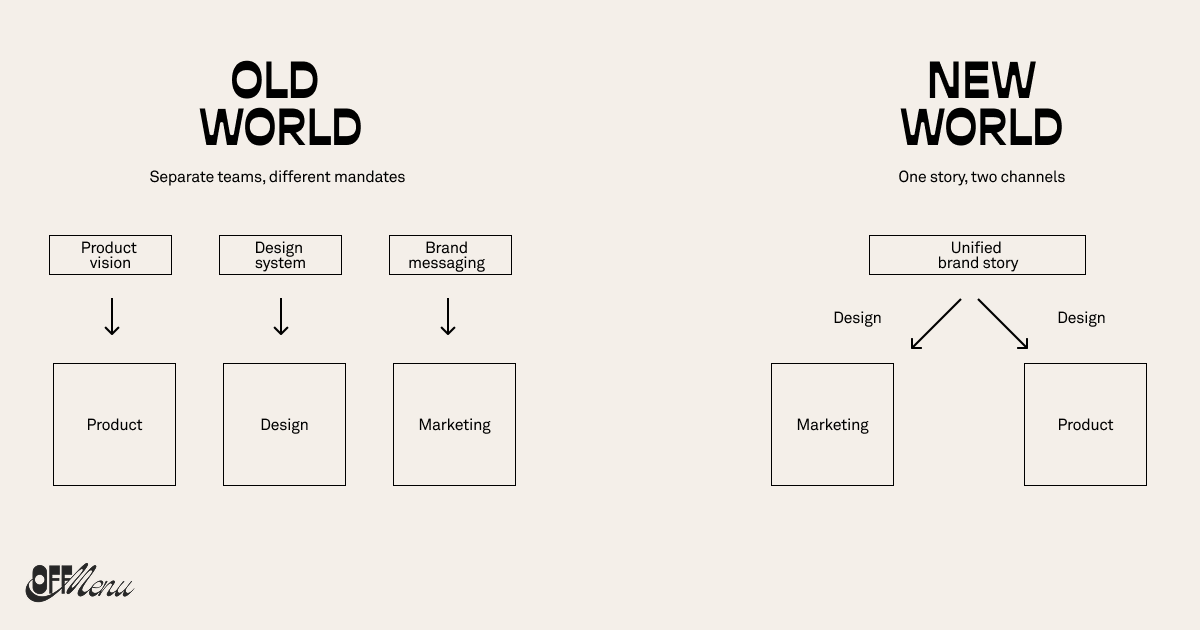
Design is the implementation layer for your narrative
It’s the thing that brings your positioning and POV to life across everything you do. In marketing that's your website, your campaigns, your decks. In product that's your UI, your onboarding, your experience.
Marketing and product aren’t separate functions competing for budget, they’re one customer journey from awareness to activation to retention. Someone discovers you through marketing, experiences your product, and either stays or leaves based on whether the story you told matches what they got. Design is what makes that journey coherent, what makes the story you tell in marketing match the experience someone has in your product.
When design is siloed off on its own, it becomes decorative, something nice but not essential. When it’s embedded in marketing and product, solving the problems those teams are measured on, it becomes strategic.
How design moves the needle
Companies need to stop organizing design as its own function. Designers need to stop thinking of themselves as executors. When both sides make that shift, the work gets better and the money shows up.
Designers who diagnose business problems before opening Figma don’t struggle to justify their salaries. Companies that put designers in charge of marketing and product outcomes don’t agonize over design budgets. The value becomes obvious because you’re measuring the same things the business cares about.
If you’re a designer reading this and thinking “that’s not my job,” the designers getting promoted and leading teams already figured out it is. If you’re a company reading this and thinking “we can’t reorganize our whole structure,” start smaller. Ask your designers to own one outcome, one metric, one business problem. See what happens when they’re solving for something that matters instead of making things look good.
The companies and designers who get this right don’t have value conversations anymore. The results speak for themselves.